


This essay offers a unique and comprehensive description of Trump’s deportation campaign written by Wayne A. Cornelius, one of the nation’s leading experts on migration.
During his 2024 presidential campaign, Donald Trump promised that, from “day one” of his return to office, he would launch the largest deportation program in American history. He pledged to remove at least one million migrants every year.
Yet, Trump faced an immediate challenge: there weren’t enough border-crossers to deport.
Most deportations regularly take place at the border, when migrants are caught attempting to cross without authorization. By the time Trump returned to power, however, illegal crossings had already fallen to levels not seen since 1970 because, between 2023 and 2024, President Biden barred asylum requests at the border and required immediate detention and removal.
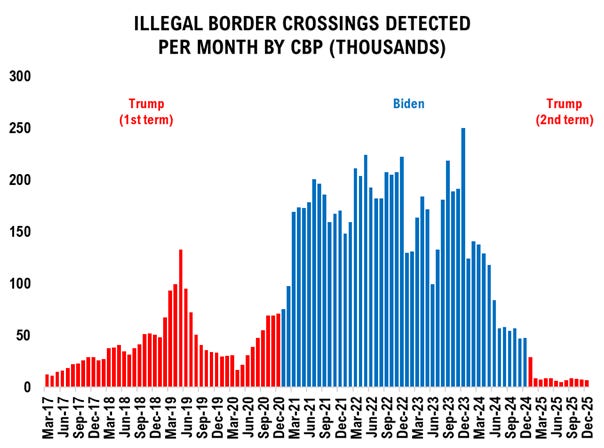
This sharp decline in arrivals meant that, to fulfill his promise, Trump had to shift his focus inward, toward deportations from within the country.
The result has been a sweeping enforcement campaign that reshapes federal power, tests the limits of executive authority, and drives the most ambitious deportation effort in modern American history.
The Four Pillars of Trump’s Deportation Campaign
Trump’s deportation campaign can be understood as built around four central ingredients.
First, it creates a legal framework to justify mass deportations by declaring false emergencies. Trump did so on the first day of his second term by declaring a “national emergency at the border” to “repel the disastrous invasion of our country.”
He also declared “crime emergencies” in specific cities such as Washington, DC, Chicago, and Los Angeles in order to bypass local sanctuary laws for undocumented immigrants and to justify the use of National Guard troops and regular military forces for immigration enforcement inside the country – something prohibited by federal law.
The second ingredient is expanding the pool of deportable immigrants. The main methodology has been eliminating the various categories of temporary protection granted to migrants of specific nationalities during the administrations of Bush, Obama, and Biden.
The notable growth in the undocumented population living in the United States during Biden’s presidency was largely due to entries through these temporary protection channels. For example, the “Temporary Protected Status” program covered individuals fleeing eight armed conflicts or natural disasters, including citizens of Afghanistan, Haiti, Honduras, Nicaragua, and Venezuela.
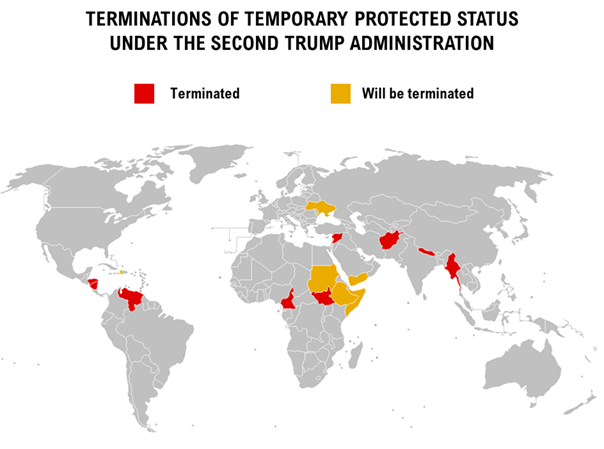
In total, 1.5 million migrants have lost the temporary protection they received under Biden. Once they lose that protection, they become immediately deportable. They may apply for other forms of authorization, such as green cards, but the requirements are strict and the process can take years.
To further expand the deportable pool, ICE has hired dozens of bounty hunters from a private prison company to identify additional deportable migrants.
The third ingredient of the mass deportation project is repositioning the Border Patrol. Federal law limits Border Patrol operations to the international border and to a zone within 100 miles of it.
However, Trump’s deportation program stations Border Patrol agents throughout the country. In 2025, agents were deployed in cities far from the Mexican border, including Boston, Chicago, Los Angeles, Washington, DC, Portland, Charlotte, and Minneapolis.
The only thing these cities have in common is that they are governed by Democratic mayors. In effect, this is retaliation against blue localities and states.
Repositioning Border Patrol agents is significant because they have a reputation for being tougher and more aggressive than agents from other agencies. Their training includes apprehending drug traffickers and other violent criminals.
The cities most affected by mass deportation operations have received hundreds of Border Patrol agents working alongside National Guard contingents from several states, as well as agents from ICE, the FBI, the DEA, and five additional federal agencies. Minneapolis alone saw more than 3,000 agents deployed, supposedly to combat corruption in the Somali immigrant community, which Trump demonized.
In Trump’s second term, the 22,000 Border Patrol agents have effectively been transformed into a roaming, increasingly militarized deportation force operating without authorization from governors in the affected states.
The fourth ingredient of the Trump project is massive spending. The tax legislation approved by Congress on July 4, 2024, titled the “One Big Beautiful Bill Act,” allocates $170 billion for immigration enforcement. That amount exceeds what every country in the world spends on its armed forces except the United States and China.
The annual budget of the Department of Homeland Security for immigration enforcement doubled between 2025 and 2026. The department is already the largest federal law enforcement agency, larger than the FBI.
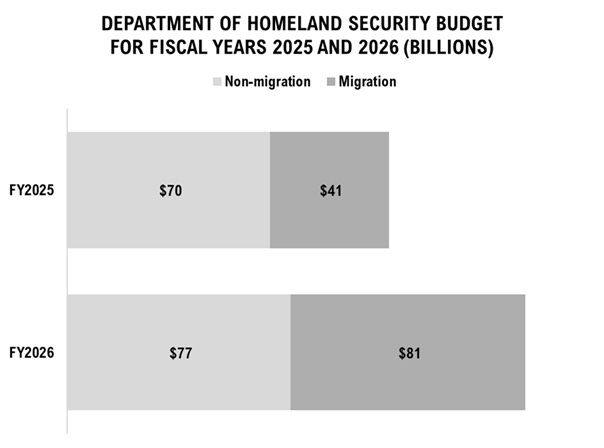
Nearly 15,000 federal agents have been reassigned from investigating non-immigration crimes to immigration enforcement. They are no longer investigating cyberattacks, transnational financial crime, drug trafficking, or human trafficking.
In short, there is no shortage of resources to carry out the mass deportation project.
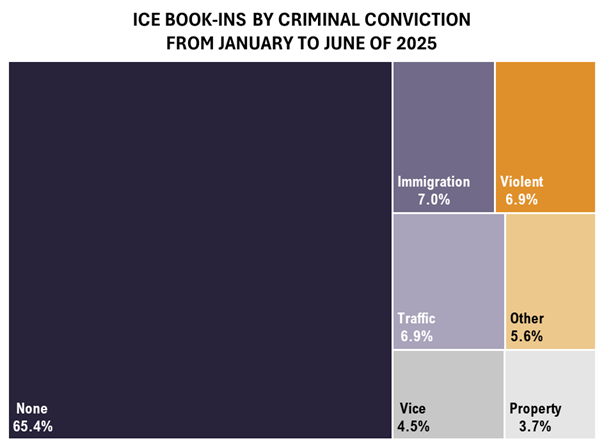
To justify expanded immigration enforcement to the general public, Trump has erased the distinction between immigration and criminality. He constantly insists that his administration is removing violent criminals, “the worst of the worst.”
The reality is very different. Data from Trump’s own government show that fewer than 30 percent of those detained in intensive ICE operations in major cities had been convicted of any crime. Many of those convicted committed low-level infractions, such as traffic violations or immigration-related offenses. They are simply not “the worst of the worst,” as Trump claims. To justify its operations, the administration argues that anyone who enters the country without legal authorization is a criminal.
How Trump Transformed Immigration Enforcement
Trump has also transformed immigration enforcement practices. Under his administration, all migrants caught in raids are detained indefinitely rather than cited and released on bond pending their court hearings, as was the practice under previous administrations. As a result, the detention and transportation system had to be expanded. The number of deportation flights has doubled.
Trump’s enforcement project includes a significant increase in deportations to “third countries”-- not the migrant’s country of origin. Deportation flights now go to more than a dozen countries, many in Africa, and the administration is negotiating with more than 60 additional countries. These governments accept deportees from the United States in exchange for millions of dollars.
There are several motives behind these third-country deportations.
First, they function as a fear tactic designed to promote self-deportation. Undocumented migrants may fear being sent to countries such as Uganda, where they do not speak the language and lack legal protections and social support.
Second, they allow the government to shut down asylum claims. Pending asylum cases can be canceled without a judicial hearing, and migrants can be deported to third countries. More than 8,000 asylum applications were canceled in 2025, and thousands of previously accepted refugee cases were reopened.
Detention capacity has expanded dramatically, with new centers in scores of cities as well as remote areas. In Biden’s final year, detention centers could hold about 39,000 people. In Trump’s second term, capacity has risen to 70,000, with plans to hold 100,000 detainees per day.
To accelerate expansion, the administration is using $10 billion in U.S. Navy funds to build new detention centers in six states. It is also turning huge commercial warehouses into detention facilities. In Florida, a massive detention complex known as “Alligator Alcatraz” was built at a decommissioned airport surrounded by the Everglades. Trump has praised both the name and the location.

The administration also signed more than 1,400 cooperation agreements with local police departments. These so-called 287(g) agreements allow local police to function as a force multiplier for the federal government, facilitating the transfer of individuals detained for non-immigration crimes from local jails to ICE. Police departments can also rent jail space to ICE for migrant detention.
Restrictions on where arrests can occur have been eliminated. Migrants can now be detained in workplaces, warehouses, gas stations, and parking lots of Home Depot stores, schools, hospitals, and churches. Arrests also occur in public spaces such as courthouses and airports, as well as during traffic stops. Street vendors and delivery workers are detained, abandoning their electric bicycles in the street.

Detentions inside courthouses have been especially shocking. Immigrants appear for routine interviews or check-ins and leave in handcuffs, on their way to detention centers. As the administration insists, “There are no longer safe spaces for illegals.”

Another ingredient of Trump’s deportation project is carrying out arrests with near-total impunity. New ICE employees watch a video of Trump senior advisor Stephen Miller declaring that agents have absolute federal immunity for actions taken in immigration enforcement. Agents have behaved accordingly.
Cities such as Los Angeles, Chicago, and Minneapolis have become combat zones where heavily armed federal agents patrol in masks and balaclavas without visible identification. The lack of identification increases brutality, as agents know they are unlikely to be held accountable.
Agents seize migrants on the street and place them in unmarked vehicles, effectively disappearing them until relatives locate them. Sometimes ICE rents commercial vehicles for raids, with agents emerging suddenly in parking lots like a Trojan horse.
The goal of all this is to create a culture of fear through super-aggressive tactics.
Use of deadly force is increasing. In Minneapolis, since January 1, two U.S. citizens have been shot and killed by federal agents. Their crime was observing and filming federal agents’ activities.
Another tactic to increase fear is denaturalization – stripping U.S. citizenship from immigrants who already have it. The responsible agency has a quota of at least 200 cases per month. There were only 24 denaturalization cases during Biden’s entire term, most involving former Nazis who had concealed their identities.
The main goal of this new denaturalization campaign is to increase insecurity among the 26 million naturalized citizens – half the foreign-born population – and push them toward self-deportation.
A constant in Trump’s project has been racial profiling to make arrests without targeting specific persons. Federal agents go door to door in residential neighborhoods in cities where concentrated enforcement operations are underway, searching for people of color to detain. They break down doors and drag residents into the street without warrants signed by a judge, thus violating the Fourth Amendment of the U.S. Constitution.
In these indiscriminate raids, hundreds of U.S. citizens, lawful permanent residents, and refugees with official status or pending cases have been detained. The tactic is to detain first and ask questions later, or never.
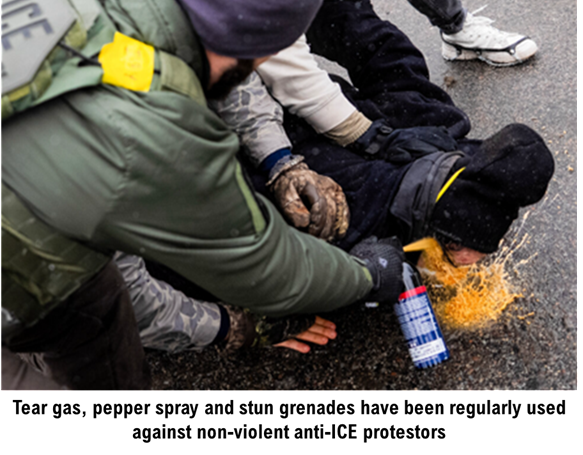
A striking element of the mass deportation project has been acts of performative violence staged for television and social media, as part of the administration’s propaganda campaign. Treatment of protesters has been especially brutal. Trump officials label them “domestic terrorists.” Tear gas canisters, stun grenades, rubber bullets, and pepper balls are routinely fired directly at protesters’ faces.
A particularly cruel tactic is encouraging self-deportation through threats of family separation. Parents are asked whether they wish to be deported with their children, many of whom were born in the United States, or whether ICE should place the children with someone else or in foster care.
The Real Results of Trump’s Mass Deportation Campaign
The campaign to promote self-deportation has fallen short. The Trump administration claims that 2.5 million people were deported in the first year of his second term, including nearly two million who allegedly left voluntarily. Its own official data, however, show roughly 500,000 deportations and 40,000 voluntary departures – far below the goal of one million per year. Mexican sources report that 145,000 Mexicans left the United States in 2025, about 10 percent of them voluntarily.
This shortfall is not due to a lack of effort. ICE has launched a multimillion-dollar publicity campaign with the message, “Leave, or be pursued and captured.” It introduced an app called “CPB Home” that offers $3,000 and a free plane ticket to those who agree to leave voluntarily. The agency also released promotional videos, including one on Christmas Eve featuring a Santa Claus dressed as an ICE agent detaining migrants and urging others to self-deport.

The deportation campaign has not only fallen short of its goals, but has also steadily eroded Trump’s standing on immigration since January 2025.
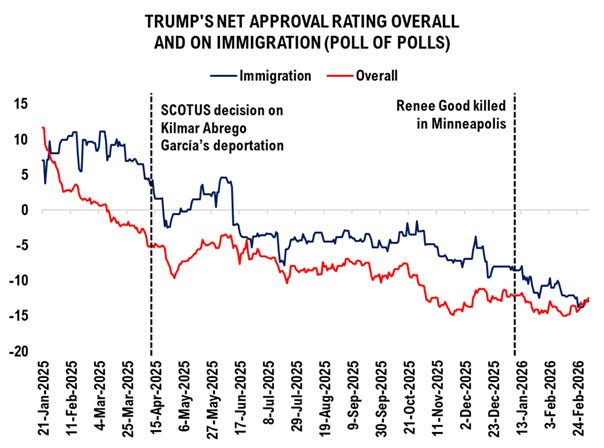
On what was once his strongest issue, he now has a negative approval rating of 17 points in the latest national poll. Nearly two-thirds of the public believe ICE has gone too far in enforcing immigration laws, including 71 percent of independents and nearly one-third of Republicans. While about half of Americans support strict border enforcement, large majorities oppose detaining long-term undocumented residents with no criminal record and reject the use of masked agents or unmarked vehicles in enforcement operations.
Neither does the public support the construction of a secret police force in the United States: a heavily armed, paramilitary body operating as a personal instrument of the president, as ICE has increasingly come to resemble in Trump’s second administration.
In the end, public opinion remains the strongest check on extremism in immigration enforcement. The growing rejection of the mass deportation project is already reshaping the political landscape and could have major consequences in the elections ahead.
The pendulum appears to be swinging, and future historians may well remember this campaign as a dark, painful, but relatively brief chapter in the American experience.
