

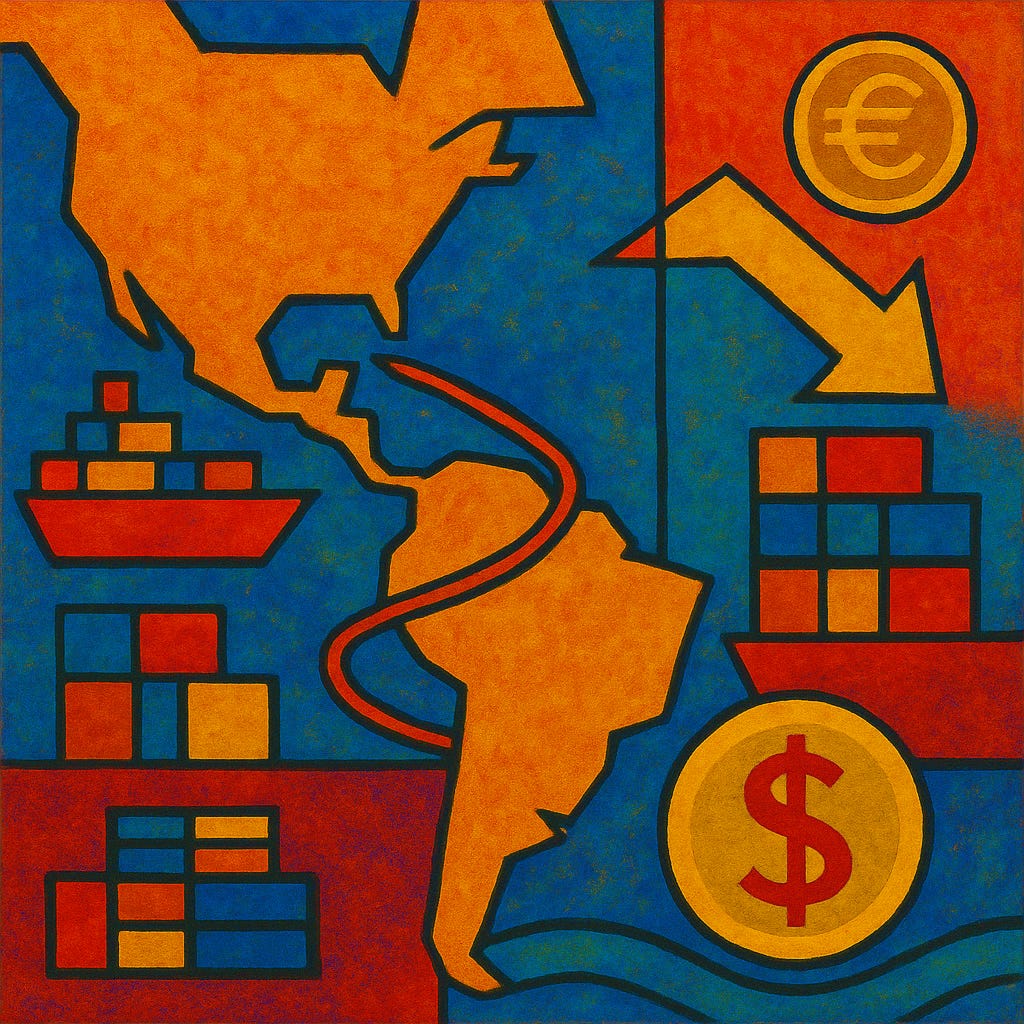
As the United States and Mexico prepare to reopen negotiations on their trade pact, a review required every six years and due in 2026, something troubling has begun to emerge.
Unlike previous rounds —when the partnership between the U.S. and Mexico was promoted as part of a “nearshoring” or “friendshoring” strategy that aimed to move production away from China and into countries geographically closer and politically aligned— this time Donald Trump is setting the stage for something far more consequential: a new economic hierarchy in North America.
Look closely at what Trump’s team is demanding from Mexico, and the goal becomes unmistakable.
He is not seeking mutual prosperity. Trump is seeking control. Few of the requests are genuinely bilateral or focused on integrating production chains. Most aim to force Mexico to rewrite its regulations in favor of American firms, granting them privileges in sectors from energy to telecommunications while limiting the Mexican government’s ability to support its own industries.
Among Trump’s most audacious demands is the right for the U.S. government to veto or condition foreign investments in Mexico, essentially replacing Mexico’s own Foreign Investment Commission with oversight from CFIUS, the U.S. agency that screens foreign investment for national security risks. The subtext is clear: if Washington deems a Chinese, European, or even Mexican-backed project undesirable, it can pressure Mexico to block it.
Mexico is also expected to mirror U.S. export and technology restrictions. That means banning platforms such as LOGINK, China’s logistics management system, and Huawei’s telecom infrastructure, even if doing so harms Mexican connectivity or trade with Asia. Another U.S. request requires Mexico to disclose detailed data about the origin of its steel imports, effectively allowing Washington to sanction Mexico if it buys materials from countries the U.S. labels unfriendly.
This approach is spreading globally. Washington is already pressuring Europe to exclude Huawei from its telecom networks, urging South Korea and Japan to cut tech ties with China, and penalizing European firms that trade with countries under U.S. sanctions.
In Mexico’s case, however, Washington is going further by adding case-by-case interventions to favor U.S. corporations. Trump’s team wants Mexico to compensate Vulcan Materials, a company whose limestone extraction site was shut down to create a protected natural reserve, and to restore business privileges to IGY Marinas in Cabo San Lucas.
Some requests are not designed to facilitate trade at all but to weaken Mexican competitors: limiting domestic “denominations of origin” and forcing acceptance of genetically modified corn that could undermine native varieties. Other demands are astonishingly granular, ranging from fast-tracking visas for American executives to softening Mexico’s sanitary and patent regulations to ease the entry of U.S. pharmaceutical and agricultural products.
Trump’s negotiators also frame certain measures as environmental protections, such as stricter rules for avocado and fishing industries. Yet these proposed standards often exceed those applied in the U.S. itself, suggesting they aim less to protect biodiversity than to erode Mexico’s cost advantage in global markets.
Inside Mexico, the response from officials has been remarkably compliant. Some see these U.S. proposals as the price of stability or even as steps toward modernizing the economy. But that pragmatism hides a deeper failure: Mexican negotiators, eager to avoid friction with Washington, may be locking their country into a dependent role in which growth depends on American permission.
Once regulatory sovereignty is traded for predictability, industrial policy disappears. Mexico will no longer decide which technologies to adopt or which industries to promote. It will simply execute Washington’s industrial strategy, the way smaller European economies once followed London’s lead in the 19th century, with predictably poor results.
The world should pay attention. What is unfolding in Mexico offers a glimpse of what Trump, and much of Washington’s foreign policy establishment, envision for all of America’s allies: a world where partnership means obedience and free trade comes with political strings attached.
If Mexico, a country that shares 2,000 miles of border and 900 billion dollars in annual trade with the U.S., can be pressured into surrendering its autonomy, then no ally is truly equal, not Canada, not Germany, not Japan.
Viri, Thank you, you provided a great analysis. The framing captures the core issue: this is not just a negotiation about trade, but also about hierarchy and control.
Mexico, like all nations, must navigate a path forward with an increasingly volatile and unpredictable United States. Its high degree of economic dependence makes this especially complex, yet Mexico also possesses structural strengths—resilience, adaptability, and a deeply integrated and competitive production base.
It is worth remembering that the interdependence runs both ways. Trade friction (and lack of cooperation in other areas) can lead to negative economic and political impacts for the U.S. as well, and people in the U.S. generally have less tolerance for such effects. The political disruption for a U.S. president is greater than for a Mexican president. Furthermore, the U.S. relies on Mexico to remain competitive in global markets, exporting value-added goods made possible through Mexican supply chains, expertise, and labor.
The challenge ahead is to preserve sovereignty and balance within that mutual dependency. This article underscores why that balance is both fragile and essential. Given the volatile nature of the U.S. president, this will remain a dynamic situation for Mexico and all other nations.
Viri, consider this: unless Mexico develops its own internal capabilities, we will always be at a disadvantage in international negotiations. Relying on a larger power for help—whether the US, China, or Russia—is not a sustainable strategy, as history shows this often leads to unfavorable outcomes.
The root of the problem is that a country plagued by educational deficits, corrupt politicians, and widespread poverty dependent on welfare is fundamentally unstable. Our tax base is unsustainable; the top 25% or less carries the burden for the rest. We cannot simply keep raising taxes, as we'll drive away companies and talented individuals—just look at what happened in France.
For a real turnaround, the government must focus on core priorities. First, it needs to professionalize the energy sector (Pemex and CFE) to at least break even, using technical expertise instead of political appointments. This alone could contribute significantly to the national budget. Second, social programs like non-contributory pensions should be reformed to encourage positive behaviors like education, health, and family planning, rather than fostering dependency.
If we continue on this same path, we will only grow poorer, like other failed Latin American states. While the productive will always find a way, we need a national shift in mentality towards building capability.
I recognize the issues of inequality and privilege, but success is also built on hard work and skill. I know plumbers, for example, with no special privilege who earn 15,000 to 20,000 pesos a week through sheer effort. There are many such examples.
Ultimately, Mexico must build its own success to negotiate as an equal. Otherwise, we are condemned to accept whatever is offered—a dynamic we've been stuck in since the 1800s.